
Fair Workweek Software
Automate scheduling and stay ahead of regulations
Fair Workweek compliance comes down to three things: staying ahead of predictive scheduling rules, calculating pay correctly when premiums apply, and keeping records ready if you're ever audited.
Get a demo
8,134 + reviews
Fair Workweek compliance comes down to three things: staying ahead of predictive scheduling rules, calculating pay correctly when premiums apply, and keeping records ready if you're ever audited.
8,134 + reviews

Build compliant schedules from the start
-
The AI Scheduling Agent builds schedules around Fair Workweek rules from the start. Describe what you need or set compliance validations to ensure every schedule is generated with local requirements already factored in.
Make informed scheduling decisions
-
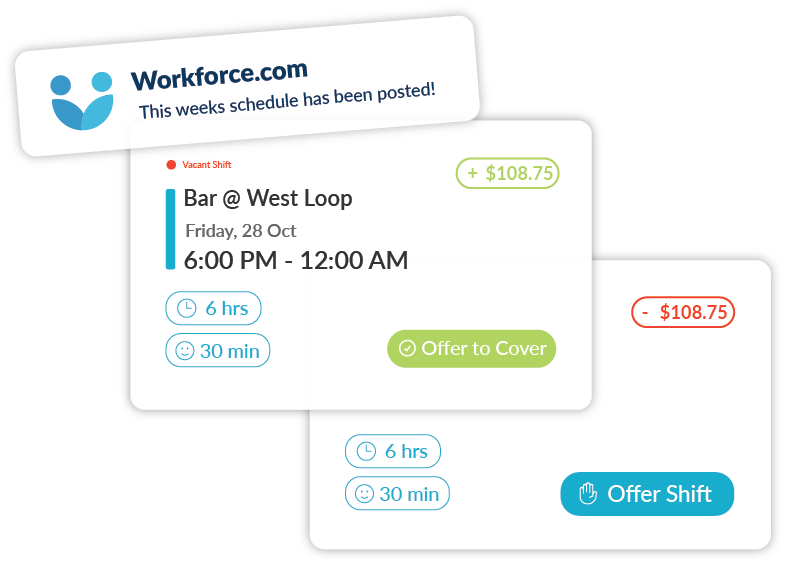
See the estimated cost of a schedule change, like a predictability pay penalty, before you confirm it. Catch violations before they hit payroll, not after.
Ensure rest periods with built-in protections
-
Automatically flag schedules that violate clopening or time-between-shifts rules. Configure thresholds by location so every site stays on the right side of its local ordinance.
Automatically calculate predictability pay
-
Premiums are based on the employee's correctly calculated pay rate, and grace periods are configurable by city so every location is calculated on its own terms.
Pay staff correctly
-
Each reassignment triggers two separate calculations—one for the employee losing the shift, one for the employee picking it up. The same precision applies when overtime and a schedule change overlap: the system accounts for both without double-paying.
Collect key information at clock in and out
-
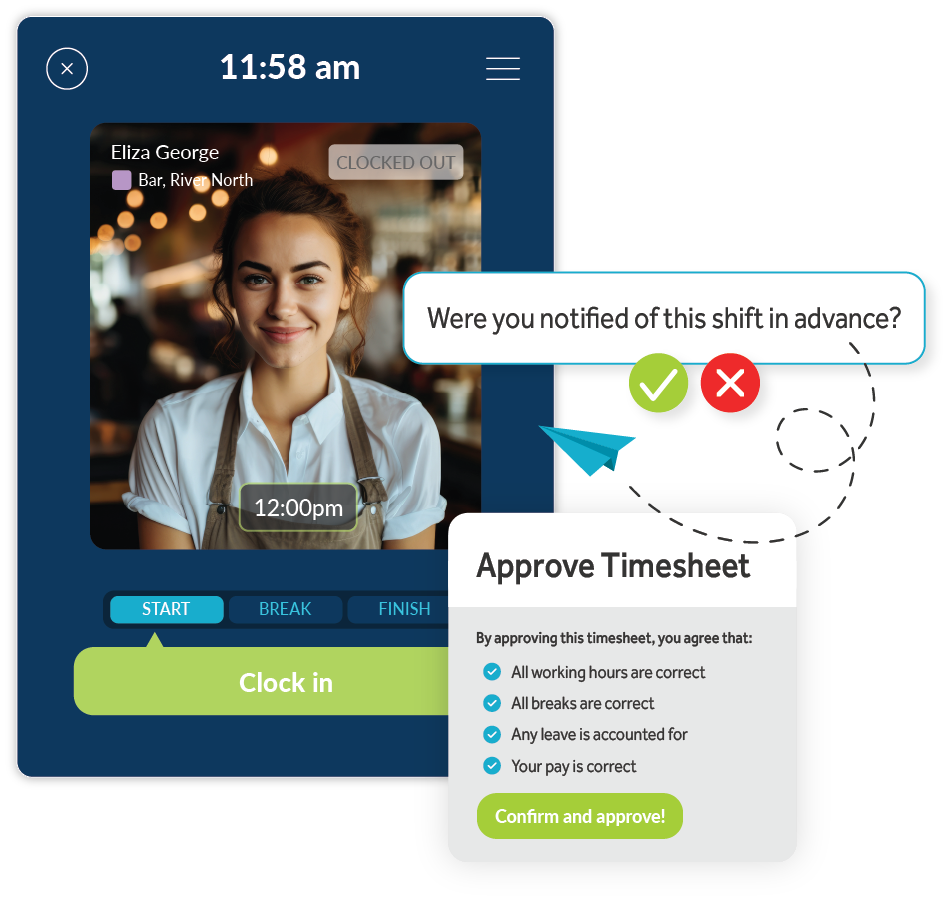
Gather required Fair Workweek data directly from employees at clock-in or clock-out. When staff request or confirm a change, it's documented automatically.
Meet advance notice requirements
-
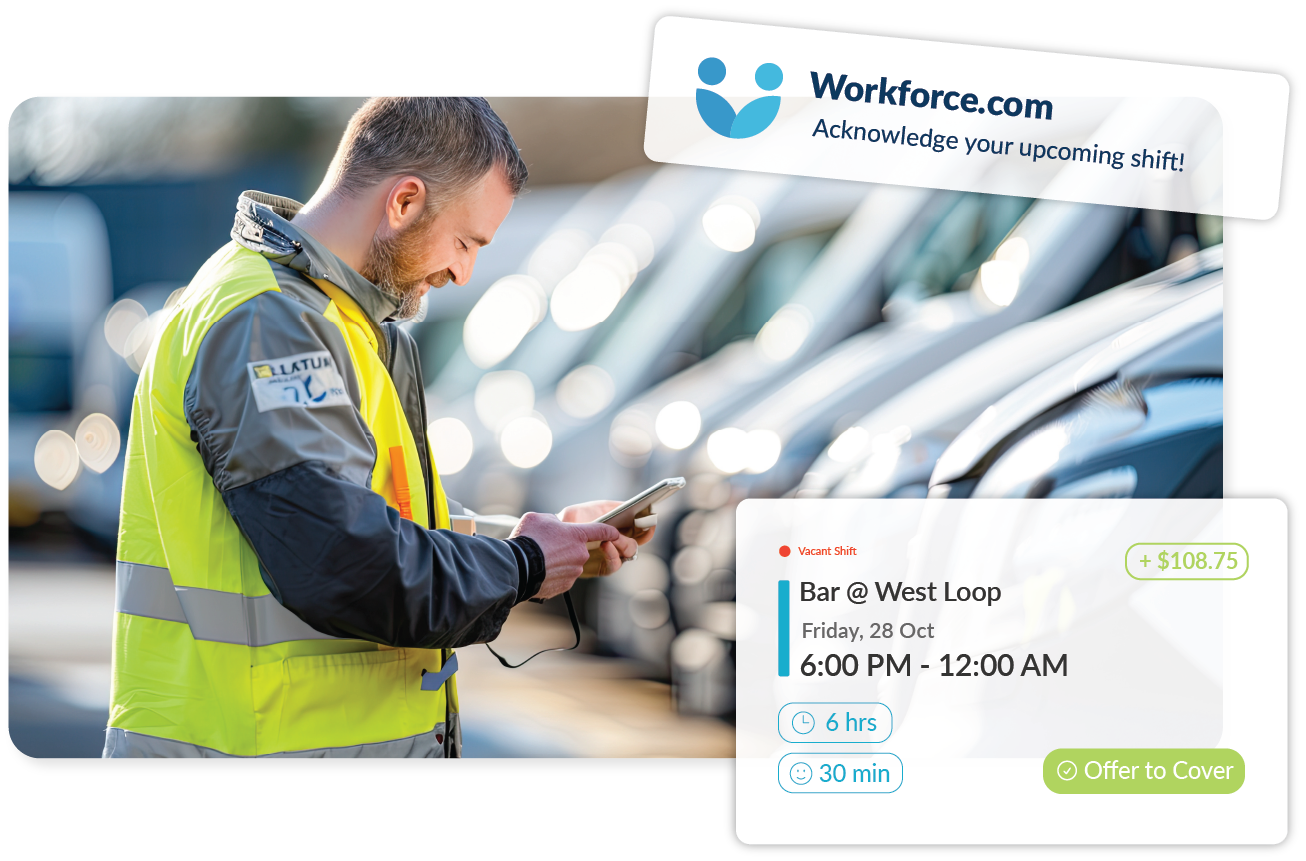
Enable employees to acknowledge shifts in advance, ensuring clarity and compliance with advance notice requirements.
What's Included
-
Want to learn more about a specific feature?
Get a demo
-
Automated Compliance Validations
Clopening Protections
Automated Allowances
AI Scheduling Agent
Time Clock Questions
Shift Acknowledgement
Reporting and Audit Tracking
Payroll
Oregon
14-day advance notice, predictability pay and rest rules apply unless noted.
Statewide
Businesses with 500+ employees.
Covered employers
Employers in the retail, hospitality, and food service industries with 500 or more employees worldwide.
Advance notice period
- Written work schedules at least 14 days in advance, including on-call work
- Good faith estimates upon hiring
- Employees may decline shifts that are not included in the posted schedule
Predictability pay
Employees are entitled to additional compensation when schedules are changed without sufficient notice:
- One hour of additional pay at the regular rate, in addition to wages earned, when:
- Time is added to a shift (30 minutes or more)
- The date or start/end time of a shift is changed without reducing hours
- An additional shift or on-call shift is added
- Half the employee’s regular rate of pay for lost hours when:
- Hours are reduced
- Changes that result in loss of shift hours
- A shift is canceled
- An on-call shift is not ultimately worked
Rest hours and clopening
There must be a 10-hour rest period between shifts. Employees can decline the rest period and be paid at time and a half.
Exceptions
Additional pay is not required for schedule changes due to natural disasters or events outside an employer’s control, such as floods, earthquakes, tsunamis, wildfires, extreme temperatures, war, or explosions.
California
14-day advance notice, predictability pay and rest rules apply unless noted.
Berkeley
Businesses with 56 to 100+ employees, depending on industry.
Covered employers
Employers operating in the City of Berkeley with 10 or more employees in Berkeley, and:
- 56 or more employees globally in industries such as retail, hospitality, healthcare, building services, manufacturing, and warehouse services
- 100 or more employees globally if they are:
- Restaurant employers
- Franchisees in the retail or restaurant industries
- Nonprofit organizations in covered industries
Advance notice period
- Written work schedules at least 14 days in advance, including on-call work
- Good faith estimates upon hiring
Predictability pay
- 1 hour of predictability pay for any schedule change made between 1 and 14 days before a shift
- Up to 4 hours of predictability pay (or the number of hours reduced, whichever is less) for cancellations or reduced hours with less than 24 hours’ notice
- 1 hour of predictability pay for adding, changing, or moving a shift with less than 24 hours’ notice
Rest hours and clopening
Employers must allow employees to decline shifts that occur less than 11 hours apart.
Exceptions
Predictability pay is not applicable to employee-initiated shift swaps or changes. It is also not owed for grace periods of 10 minutes before and after a shift.
Access to hours for existing employees
Employers must offer any additional hours to existing part-time employees before hiring new staff or temporary workers.
Emeryville
Retail and fast food businesses with 20 to 56 employees, depending on location.
Covered employees
Employers with nonexempt full-time, part-time, on-call, contract, and seasonal employees that are in:
- Retail with 56 or more employees globally
- Fast food with 56 or more employees globally or 20 or more employees in Emeryville
Advance notice period
- Written work schedules at least 14 days in advance
- Good faith estimates upon hiring
- Employees can decline unscheduled hours given less than the notice
Predictability pay
- 1 hour of pay if a schedule change is made between 1 and 14 days before the shift
- The lesser of 4 hours of pay or the originally scheduled hours for cancellations or reduced hours with less than 24 hours’ notice
- 1 hour of pay for any other changes made within 24 hours
Rest hours and clopening
Employers must pay time and a half for any hours worked on shifts that are less than 11 hours apart. Employees have the right to decline shifts less than 11 hours apart.
Exceptions
Predictability pay is not required in certain situations, including:
- Employee-initiated changes, such as voluntary shift swaps or requests to modify a schedule
- Minor schedule adjustments, including changes of 10 minutes or less before or after a shift
- Events outside the employer’s control, such as natural disasters or utility failures
- When employees work past their scheduled shift to complete a transaction that results in a commission or tip
- Mutually agreed-upon changes, where employees voluntarily accept additional work in advance
Access to hours for existing employees
Employers must offer additional hours to existing qualified part-time employees until they reach 35 hours of work in a calendar week, in at least 4-hour increments.
Recordkeeping requirements
Employers must maintain records for at least three years.
San Francisco
Formula retail businesses with 40+ locations worldwide and 20+ employees in the city.
Covered employers
Formula retail establishments with 40 or more locations worldwide and 20 or more employees in San Francisco, including janitorial and security contractors.
Advance schedule notice period
- Written work schedules at least 14 days in advance
- Good faith estimate of hours upon hiring
Predictability pay
Employees are entitled to predictability pay for schedule changes made with less than 7 days’ notice, including:
- Added or changed shifts
- Reduced or canceled shifts
- Unused on-call shifts
The amount of pay varies depending on the type and timing of the change.
Exceptions
Predictability pay is not required in certain situations, including:
- Threats to employee safety, property damage, or events outside the employer’s control
- Employee-initiated schedule changes or shift swaps
- When an employee fails to report to work or is sent home for disciplinary reasons
Equal treatment for part-time employees
Employers must provide part-time employees with the same starting hourly wage and access to promotions as full-time employees performing similar work.
Los Angeles
Retail businesses with 300+ employees globally.
Covered employers
Retail businesses with 300 or more employees globally.
Advance notice period
- Work schedules at least 14 days in advance
- Good faith estimate of hours upon hiring
- Employees may decline hours or shifts added after the notice period
Predictability pay
Employees are entitled to additional compensation when employers make changes to the posted work schedule:
- 1 hour of pay at the regular rate for each employer-initiated change that:
- Increases scheduled hours by more than 15 minutes, or
- Changes the date, time, or location of a shift
- Half the employee’s regular rate of pay for hours not worked when:
- Scheduled hours are reduced by 15 minutes or more
- An on-call shift is not worked
Rest hours and clopenings
Employees must not work a shift that starts less than 10 hours from the previous shift. Otherwise, employees must provide written consent, and time and a half applies to shifts following an insufficient rest period.
Exceptions
Predictability pay is not required in certain situations, including:
- Employee-initiated schedule changes
- Voluntary shift coverage for absent employees
- Reductions due to disciplinary action or policy violations
- Additional hours accepted voluntarily under the ordinance
- Events outside the employer’s control
Access to hours for existing employees
Employers must offer work to current employees at least 72 hours before hiring a new employee or using a contractor, temporary service, or staffing agency to perform work.
Recordkeeping requirements
Employers must maintain records for at least three years.
Los Angeles County
Retail businesses with 300+ employees globally operating in unincorporated areas.
Covered employers
Retail businesses with 300 or more employees globally that operate in unincorporated areas of Los Angeles County.
Advance notice period
- Work schedules at least 14 days in advance
- Good faith estimate of hours upon hiring
- Employees may decline hours or shifts added after the notice period
Predictability pay
Employees are entitled to additional compensation when employers make changes to the posted work schedule:
- 1 hour of pay at the regular rate for each change to a scheduled date, time, or location that:
- Does not result in a loss of work time, or
- Results in additional work time of more than 15 minutes
- Half the employee’s regular rate of pay for hours not worked when:
- Scheduled work time is reduced by 15 minutes or more
- An on-call shift is not worked
Rest hours and clopening
- Employees may decline shifts scheduled less than 10 hours apart
- Employees may agree to work such shifts, but must provide written consent and be paid time and a half for those hours
Access to hours for existing employees
Employers must offer additional hours to current employees before hiring new staff or using contractors or staffing agencies.
Exceptions
Predictability pay is not required in certain situations, including:
- Employee-initiated schedule changes, such as requests to modify a shift or voluntary shift swaps
- Voluntary acceptance of additional hours, including when covering for another employee’s absence, provided the employee is informed that the change is voluntary and consents
- Reductions in hours due to violations of law or company policy
- Events outside the employer’s control, such as natural disasters or public emergencies
Recordkeeping requirements
Employers must maintain records of work schedules, schedule changes, and employee consent for at least three years.
Illinois
14-day advance notice, predictability pay and rest rules apply unless noted.
Chicago
Businesses with 100 to 250 employees globally, depending on industry. Earnings thresholds also apply.
Covered employers
- Employers with 100 or more employees globally in the following industries:
- Building services
- Healthcare
- Hotels
- Manufacturing
- Retail
- Warehouse services
- Restaurant employers with 250 or more employees and at least 30 locations globally
Employer size is calculated using the average number of global employees over a 12-month period for existing employers, or over the previous 90 days for new employers.
Covered employees
Covered employees are those earning $33.85 per hour or less, or $64,945.55 per year or less. The same 12-month/90-day averaging method is used to count covered employees.
Advance notice requirements
- Notice of work schedules at least 14 days in advance
- Good faith estimate of work hours upon hiring
Predictability pay
Employees are entitled to additional compensation when schedules are changed after posting:
- 1 hour of pay for changes made with less than 14 days’ notice
For changes made with less than 24 hours’ notice:
- 1 hour of pay if employers add hours, or there is no loss of hours
- Half pay for hours not worked if hours are reduced
Exceptions
Predictability pay is not required in certain situations, including:
- Threats to employees, employers, or property, or when authorities advise against work
- Utility failures at the workplace
- Natural disasters or severe weather events
- War, civil unrest, strikes, or public emergencies
- Voluntary shift trades or coverage between employees
- Schedule changes mutually agreed upon in writing
- Employee-requested schedule changes
- Reductions in hours due to documented disciplinary action
Rest hours and clopening
Employees may decline shifts scheduled less than 10 hours apart from the end of their previous shift. If they agree to work anyway, employers must pay 1.25 times the employee’s regular rate, regardless of whether the employee requested or consented to it. Consent can be given on an ongoing basis but may be revoked at any time.
If a double-shift (consecutive shifts) falls within the 10-hour window, the entire double-shift is paid at 1.25x. For split-shifts, only the portion starting less than 10 hours after a shift spanning two calendar days triggers the premium.
Right to rest pay must be paid no later than the next payday and must be itemized separately on the pay stub.
Access to hours for existing employees
Employers must offer additional shifts to qualified employees before hiring new staff. If shifts are not accepted, they may be offered to temporary or seasonal workers.
Recordkeeping requirements
Employers must maintain records of work schedules, schedule changes, predictability pay, and employee consent for at least three years.
Evanston
Businesses with 100 to 300 employees, depending on industry and number of locations.
Covered employers
Employers with:
- 100 or more employees globally, including franchises, in the following industries:
- Hospitality
- Retail
- Warehouse services
- Manufacturing
- Building services
- Food service and restaurant employers with 30 or more locations globally and 300 or more employees globally
Advance notice requirements
- Notice of work schedules at least 14 days in advance
- Good faith estimate of work hours upon hiring
Predictability pay
Employees are entitled to additional compensation when employers make changes to the posted work schedule:
- 1 hour of pay per impacted shift when:
- Hours are added after the 14-day notice period
- The date or time of a shift is changed with no loss of hours after the 14-day notice period
- Scheduled hours are reduced with more than 24 hours’ notice
- When scheduled hours are reduced with less than 24 hours’ notice:
- Up to 4 hours of pay, or the number of hours in the scheduled shift (whichever is less)
On-call shifts
- If the employee is not compensated (or is paid below their regular rate):
- They are owed predictability pay if called in
- They are owed up to 4 hours of pay (or scheduled hours, whichever is less) if not called in
- If the employee is paid at their regular rate during the on-call shift, no additional predictability pay is required if they are called in
Rest hours and clopening
Employees must provide written consent to work shifts scheduled less than 11 hours apart. If they work such shifts, they must be paid time and a half.
Access to hours for existing employees
- Employers must offer additional hours to existing employees before hiring new staff
- Employers must offer interested employees the opportunity to work up to 35 hours per week before hiring new employees
- Additional hours may be offered across locations, not just the employee’s primary worksite
New York
14-day advance notice, predictability pay and rest rules apply unless noted.
New York City
Fast food chains with 30+ locations nationally, and retail businesses with 20+ employees in the city.
Covered employers
- Fast food establishments that are part of a chain with 30 or more locations nationally
- Retail employers with 20 or more employees in New York City
Advance notice requirements
Fast food employers
- Must provide work schedules at least 14 days in advance
Retail employers
- Must provide work schedules at least 72 hours in advance
- Employers cannot cancel a shift or add shifts without employee consent
- Cannot require on-call shifts
Predictability pay
Fast food employers
- Must provide premium pay for schedule changes made after the notice period
- Pay ranges vary depending on the timing and type of change (e.g. additions, reductions, or cancellations). It can cost $10–$75 per change made inside the notice period.
Retail employers
- Retail laws do not include predictability pay. Instead, employers may face penalties and damages for violating scheduling requirements.
Rest and clopening
Fast food employers
Employers cannot schedule employees to work shifts with less than 11 hours between shifts (“clopening”) unless:
- The employee is given the opportunity to decline
- The employee provides written consent
- The employer pays a $100 premium for each clopening shift worked
Retail employers
- No specific rest period or clopening requirements
Exceptions
Fast food employers
Fast food employers are not required to provide premium pay in certain situations, including:
- Threats to employee or employer safety or property
- Public utility failures or transportation disruptions
- Natural disasters or declared states of emergency
- Severe weather conditions
- Employee-initiated schedule changes (e.g. time-off requests or shift swaps)
Retail employers
- No formal exceptions apply. Instead, employers must comply with strict scheduling requirements, and violations may result in penalties.
Recordkeeping requirements
Fast food and retail employers must maintain records for at least three years.
Pennsylvania
14-day advance notice, predictability pay and rest rules apply unless noted.
Philadelphia
Retail, hospitality and food service employers with 250+ employees and 30+ locations globally.
Covered employers
Employers with 250 or more employees globally and 30 or more locations globally, including chains and franchises in:
- Retail
- Hospitality
- Food service
Advance notice requirements
- Notice of work schedules at least 14 days in advance
- Good faith estimate of work hours upon hiring
- Employees may decline additional hours not included in the posted schedule
Predictability pay
Employees are entitled to additional compensation when schedules are changed after posting:
- 1 hour of pay at the regular rate when:
- Time is added to a scheduled shift
- The date, time, or location of a shift is changed with no loss of hours
- Half the employee’s regular rate of pay for hours not worked when:
- Scheduled hours are reduced
- An on-call shift is not worked
Rest hours and clopening
Employees must receive at least 9 hours of rest between shifts. If they agree to work with less than 9 hours between shifts:
- They must provide written consent
- Employers must pay a $40 premium for each clopening shift
Access to hours for existing employees
Employers must offer available work hours to existing employees before hiring new staff.
Recordkeeping requirements
Employers must maintain records for at least two years.
Washington
14-day advance notice, predictability pay and rest rules apply unless noted.
Seattle
Retail and food service with 500+ employees, and full-service restaurants with 40+ locations worldwide.
Covered employers
- Retail and food service establishments with 500 or more employees worldwide
- For full-service restaurants, coverage applies only if the employer also has 40 or more full-service locations worldwide
Advance notice requirements
- Notice of work schedules at least 14 days in advance
- Good faith estimate of work hours to new hires
Predictability pay
- 1 hour of pay at the regular rate when:
- Hours are added to a shift
- The date or time of a shift is changed
- Half the employee’s regular rate of pay for hours not worked when:
- Work hours are reduced
- An on-call shift is not worked
Rest hours and clopening
Employees should receive at least 10 hours of rest between shifts. If they agree to work shifts less than 10 hours apart, they must provide consent, and employers must pay time and a half for those hours.
Exceptions
Predictability pay is not required in certain situations, including:
- Employee-initiated schedule changes or shift swaps
- Voluntary coverage for absent employees
- Reductions due to disciplinary action
- Events outside the employer’s control (e.g. natural disasters, utility failures, or public emergencies)
Recordkeeping requirements
Employers must maintain records for at least three years.
Explore our full guide for a deeper look at current Fair Workweek ordinances and requirements.